ChatGPT Wallet: Why Your Site Might Block AI Agent Purchases
ChatGPT Wallet lets OpenAI's agents buy on retailer checkouts, but bot protection and fraud rules can block them. What changed and what merchants should check.
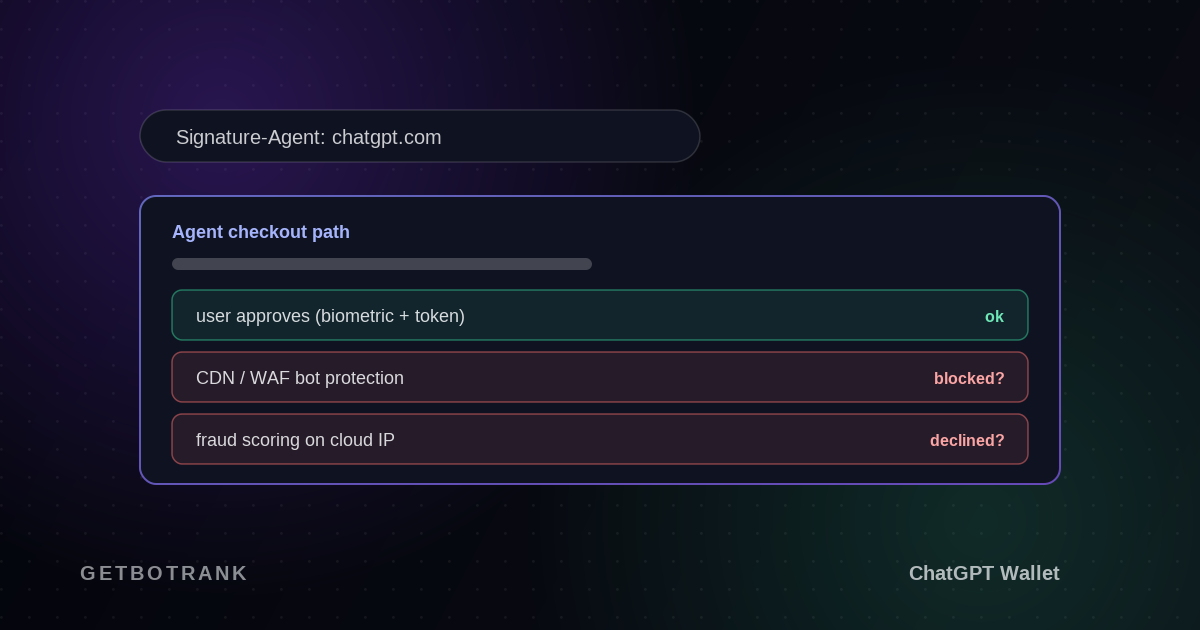
ChatGPT Wallet lets OpenAI's agents pay for things on your normal checkout, using a tokenized card the user approves with a fingerprint or Face ID. The catch for merchants is that the purchase arrives from an automated browser on cloud IP addresses, which is exactly what most bot protection and fraud scoring is built to stop. If you sell online, the work this month is not a new integration, it is making sure your own security stack does not quietly turn these buyers away.
What OpenAI launched
On November 13, 2026, OpenAI introduced ChatGPT Wallet. Per Digital Commerce 360 and The Paypers, the basics are:
- Who can use it: ChatGPT Pro subscribers in the US, 18 or older, with eligible US-issued cards. The purchases are carried out by dots, OpenAI's always-on agents.
- How it pays: the user adds a card once, reviews the items, total and card before each purchase, and approves with a biometric check. The card network then issues a token, so OpenAI says neither the merchant nor the agent sees the real card details.
- What the user keeps: card rewards and dispute protections still apply.
- What is next: OpenAI describes future delegation where users set spending limits, categories or time windows, with stronger safeguards. No date was given.
American Express, Mastercard and Visa are named as network partners. Digital Commerce 360 notes no retailers had been identified at launch, and OpenAI calls it a limited rollout.
This is OpenAI's second try at shopping. PPC Land recalls that Instant Checkout launched in September 2025 and was shut down in March 2026. The difference now is that the agent shops on the merchant's own site instead of an in-chat checkout, which puts your infrastructure in the path.
Why legitimate agent purchases get blocked
OpenAI itself warns that some sites may unintentionally block agent purchases, and that risk systems may flag legitimate ones, leading to declines or cancellations (The Paypers). There are three common failure points:
- Bot protection at the edge. A headless browser from a data center looks like a scraper. If your CDN or WAF challenges or blocks automated traffic by default, the agent may never reach the product page.
- Fraud scoring at checkout. A developer who looked up a sample of the IP ranges in OpenAI's published ChatGPT-User list found every tested address on Microsoft's network, and most flagged as hosting facilities (DEV Community). A risk model that penalizes hosting IPs or a mismatch between card country and IP country can decline a real customer.
- Rules nobody remembers writing. Many sites block AI agents because of a default bot setting or an old firewall rule, not a deliberate decision.
This is not hypothetical. PPC Land reports a test by Blend in which its shopping agent was refused by bot protection at 29 of 200 UK and US retailers.
How OpenAI's agent identifies itself
The good news is that the ChatGPT agent is one of the easier agents to verify. Per OpenAI's cloud browser access guide and a summary of its Commerce Partner Playbook by The Keyword:
- Signed requests. The agent signs requests with Web Bot Auth, which uses HTTP Message Signatures. Requests carry Signature, Signature-Input and Signature-Agent headers, with the Signature-Agent pointing to chatgpt.com. Public keys are published at chatgpt.com/.well-known/http-message-signatures-directory.
- Automatic verification at major CDNs. Akamai, Cloudflare, HUMAN and Vercel verify these signatures, and each exposes the verified ChatGPT agent as a known bot you can allow. Cloudflare Radar lists it as a verified agent operated by OpenAI. If you run a different CDN or your own firewall, you need to verify the signature against the published keys yourself.
- A Forwarded header for risk tools. The Keyword reports OpenAI now sends a Forwarded header with user-level signals such as country, locale and time zone, so fraud systems can score the human behind the agent rather than the cloud IP.
- Separate from crawlers. OpenAI treats cloud browser visits separately from crawlers like OAI-SearchBot, and separately from product feeds. Allowing one does not allow the others.
One thing OpenAI does not offer yet: controls over which actions the agent can take on your site. The Keyword reports that OpenAI requires human review before consequential actions and treats agent orders as if the customer placed them.
Why this matters for AI visibility, not just payments
It is tempting to file this under "payments team." But agent shopping sits at the end of the same chain that AI search visibility starts. A buyer asks ChatGPT for a recommendation, ChatGPT names a few brands, and now the agent can go and buy. If ChatGPT never mentions you, you are not in the running. If it mentions you but your site blocks the agent, the sale goes to the next brand on the list.
OpenAI's playbook makes the link explicit: its first step for merchants is to claim the ChatGPT business profile and upload a product feed with current pricing and availability, before any firewall work. We covered that profile in our guide to ChatGPT Business Hub.
What to do this month
- Test your edge. Ask whoever owns your CDN or WAF whether verified bots are allowed, and specifically whether the verified ChatGPT agent is set to allow. On Cloudflare, Akamai, HUMAN or Vercel this is a setting, not a project.
- Talk to your fraud provider. OpenAI named Forter, Riskified, Sardine and Signifyd, plus Adyen, Checkout.com and Stripe, as partners working on recognizing agent purchases. Ask your provider whether it reads the Forwarded header and how it scores hosting-network IPs on signed agent sessions.
- Watch your decline logs. Look for declined or cancelled orders from data center IPs with valid card tokens. A spike after mid-November is a signal worth investigating, not just blocking.
- Keep crawler access and agent access separate in your head. Your robots.txt rules govern crawlers like OAI-SearchBot and ChatGPT-User; your firewall governs the signed agent. Check both. The free AI crawler access tool shows which AI crawlers your robots.txt allows on a given URL.
- Claim your ChatGPT profile and fix your product data. Agents can only buy what they can find and trust. Accurate pricing, availability and policies on your pages and feed reduce the chance of an abandoned or wrong order. Our ecommerce AI visibility playbook covers the content side.
Where GetBotRank fits
Wallet raises the stakes on two questions: does ChatGPT recommend you, and can its tools actually reach your pages? GetBotRank's Visibility Tracker runs buyer-intent questions across ChatGPT, Claude and Gemini on a schedule so you can see whether you are named, and the page audits flag crawler access and rendering problems that keep AI systems from reading your pages, then let you verify the fix. If you want a starting point, the free AI visibility audit checks AI crawler access on your key pages with no signup. Firewall and fraud settings for the signed agent still live with your CDN and risk vendors.
The bottom line
ChatGPT Wallet is small today: US only, Pro only, limited rollout. But it is the first time a major AI assistant can pay on your own checkout, and the defaults of most security stacks are set to stop it. Allow the verified agent at the edge, make sure your fraud tools score the person rather than the cloud IP, and keep earning the recommendation that sends the agent to you in the first place.
Frequently asked questions
What is ChatGPT Wallet?
ChatGPT Wallet is a payment feature OpenAI launched on November 13, 2026 that lets its always-on agents, called dots, complete purchases on a retailer's own checkout. It is limited to ChatGPT Pro subscribers in the US with eligible US-issued cards, and the user approves each purchase with a biometric check before a network token is issued in place of the real card number.
Do merchants need to integrate anything to accept ChatGPT Wallet purchases?
According to coverage of OpenAI's payments guidance, no Wallet-specific integration is required, because the agent uses your normal checkout. The practical work is making sure your CDN, firewall and fraud tools recognize OpenAI's signed agent requests instead of treating them as bad bots or risky orders.
How do I let ChatGPT's agent through my bot protection?
OpenAI's agent signs its requests using Web Bot Auth (HTTP Message Signatures) with a Signature-Agent value of chatgpt.com. OpenAI's guidance says Akamai, Cloudflare, HUMAN and Vercel verify these signatures automatically, and each has a setting to allow the verified ChatGPT agent. Other CDNs need to verify the signature against OpenAI's published keys.
Is allowing ChatGPT's agent the same as allowing OAI-SearchBot?
No. OpenAI treats cloud browser visits by its agent separately from crawlers such as OAI-SearchBot and from product feeds. Allowing one does not allow the others, so check your robots.txt rules for crawlers and your firewall rules for the signed agent independently.