AI Search Visibility for Ecommerce Brands: A Holiday 2026 Playbook
AI-referred retail traffic is forecast to rise 130% this holiday season. How ChatGPT and Google AI Mode pick products, and what ecommerce brands should fix now.
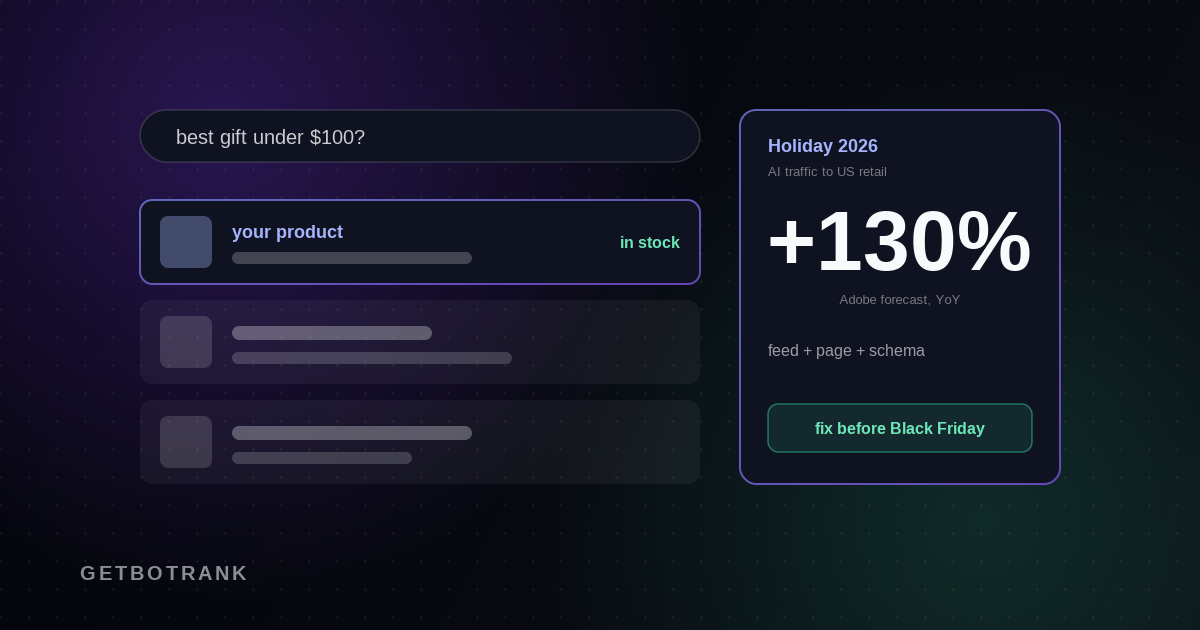
AI search visibility for ecommerce brands comes down to two things: whether assistants like ChatGPT and Google AI Mode can read accurate, structured data about your products, and whether they find enough trustworthy context to recommend you over a competitor. This holiday season the stakes are higher than ever. Adobe expects traffic from AI tools to US retail sites to grow 130% year over year between November 1 and December 31, so the gift guides shoppers ask a chatbot for are now a real acquisition channel.
This post explains how products get picked in AI answers, what changed for merchants in 2026, and a short list of fixes you can still ship before Black Friday.
The numbers behind the shift
Adobe's 2026 holiday forecast, published September 28 and based on Adobe Analytics data from over 1 trillion visits to US retail sites, projects $275.1 billion in US online sales for November and December, up 6.7%. Within that, AI-referred traffic (shoppers clicking a link from an AI chat or browser tool) is expected to rise 130%. Adobe expects the biggest jump on Thanksgiving, at 159%, followed by Black Friday at 95% and Cyber Monday at 88%.
The same release cites a July survey of 5,000 US consumers: 77% of people who had used AI for shopping said it made them more confident in what they bought.
Retailers are building for it. Startup Fortune reported on October 21 that Target's shopping experience inside ChatGPT is back for a second holiday season, letting shoppers describe an occasion, get product ideas and check out with pickup or delivery.
One caveat: Adobe counts clicks. Shoppers who get an answer and never click, or who buy later through a branded search, do not show up as AI traffic. We covered how much of this lands in your analytics as direct traffic in Your AI Referral Traffic Is Hiding in 'Direct'.
How AI assistants pick products
No assistant publishes a ranking formula, but the inputs are now documented well enough to act on. There are three main sources.
1. Structured product feeds
OpenAI's developer docs now describe a product feed upload that submits product data for discovery in ChatGPT. The required basics are item ID, title, description, product URL, brand, seller name, image URL, availability and price. The docs ask merchants to update the feed when a sale starts or ends and when stock changes. Two details matter for expectations: search eligibility is on by default, but the docs state eligibility does not guarantee display, and checkout inside ChatGPT is a separate integration.
Google went further. At Google Marketing Live in May 2026 it announced conversational attributes in Merchant Center, product data that its AI uses to match listings to conversational queries in AI Mode, Gemini and other AI surfaces. PPC Land's breakdown lists eight fields, including:
- Product highlights: short benefit statements, with Google recommending four to six per product.
- Product details: structured specs such as material or dimensions.
- Question and answer: up to 30 pairs per product.
- Related products: accessories, substitutes, parts of a set.
- Document links: manuals and guides, which must be crawlable by Googlebot.
- Popularity rank: a 0 to 100 score that should reflect real sales.
2. Your product pages
Assistants also browse. A product page that renders its price, stock and specs only through client-side JavaScript may look empty to a crawler. A Stellagent analysis of ChatGPT shopping describes web crawling that reads JSON-LD Product, Offer and Review markup as one of its data routes, alongside merchant feeds and partner APIs. The same piece notes that in March 2026 OpenAI shifted its shopping focus toward discovery and comparison, with checkout often returning to merchant sites. That makes your own product page the place the sale closes.
3. What others say about you
When a shopper asks for "the best carry-on for a family trip," the answer reflects reviews, comparison articles and forum threads as much as your catalog. You cannot control that layer, but you can make sure the facts it repeats (sizes, materials, warranty, return policy) are stated clearly on your site, so the model has an authoritative version to match against.
Measuring it is getting easier, slowly
Google's AI performance insights report in Merchant Center will show share of voice against similar brands across AI Mode, AI Overviews and the Gemini app, broken down by funnel stage (discovery, evaluation, purchase), plus which product attributes shoppers ask about and where your feed is missing them. Google says it is coming to the US, Canada, Australia, India and New Zealand in the coming months, so many merchants will not have it for Cyber Week.
It also only covers Google. For ChatGPT, Claude and Gemini outside of Google Search, you still need to run real buyer questions yourself and track whether your brand appears. That gap is why we built GetBotRank's Visibility Tracker: it runs buyer-intent questions across ChatGPT, Claude and Gemini on a schedule and tracks your mention rate over time, so you can see whether a fix moved anything.
What to do before Black Friday
You have about two weeks. Prioritize what is cheap and high impact.
- Write down 10 to 20 shopper questions. Use the phrasing a gift buyer would type: occasion, recipient, budget, constraint. Run them in ChatGPT, Gemini and Claude today, note which brands appear, and save the answers as your baseline.
- Audit your top 20 product pages for readability. Check that price, availability and key specs appear in the raw HTML, not only after JavaScript runs. The SSR Checker shows what a page looks like without JavaScript.
- Validate Product and Offer markup. Price, currency, availability, brand and review data should match what the page shows. Run key pages through the Schema Validator and fix errors first, warnings second.
- Make sure AI crawlers are allowed in. A bot blocked in robots.txt or at the CDN cannot read your holiday pages. The AI crawler access checker tests the main AI user agents against your URLs.
- Fill the Merchant Center gaps you can. Product highlights and Q&A pairs are the quickest wins, since you can often reuse copy from your product pages and support FAQs. Keep popularity rank honest.
- Submit or refresh your ChatGPT feed if you are eligible. Keep price and availability in sync during sales, since a stale price is worse than none.
- Answer the comparison question on your own site. A plain-text sizing guide, a "which model is right for you" page or a clear returns page gives assistants a quotable source. Our guide on structuring content so LLMs cite it covers the format.
- Re-run your questions weekly through December. Answers shift as models refresh their sources, and you want to know before January whether the work paid off.
The bottom line
AI shopping is no longer a test channel. Feeds are now documented by both OpenAI and Google, AI-referred traffic is forecast to more than double this season, and checkout is flowing back to merchant sites. The brands that show up will be the ones whose product data is complete, whose pages are readable without JavaScript, and who check the answers instead of assuming.
If you want a fast starting point, run a free AI visibility audit on your best-selling product page. It checks whether AI crawlers can reach and read it, and flags what to fix first.
Frequently asked questions
How do ChatGPT and Google AI Mode decide which products to recommend?
Neither publishes a ranking formula. Both draw on structured product data (OpenAI's product feed for ChatGPT, Merchant Center for Google's AI surfaces) plus what they can read on the web, including your product pages and third-party reviews. OpenAI's feed documentation says eligibility does not guarantee display, so complete data gets you considered, not ranked.
Do I need to submit a product feed to appear in ChatGPT shopping results?
Not strictly, since ChatGPT can also surface products it finds through web search. But OpenAI now documents a product feed upload for discovery in ChatGPT, with nine required fields such as title, description, brand, price and availability. If you can submit one, it removes guesswork about your prices and stock.
What are Google Merchant Center conversational attributes?
They are product data fields Google introduced in 2026 for conversational surfaces like AI Mode and Gemini. Examples reported by PPC Land include product highlights, product details, question and answer pairs, related products, document links and popularity rank. Google says its AI uses this data to match products to conversational queries.
How can I measure whether AI assistants recommend my products?
Run the questions your buyers actually ask (for example, best running shoes for flat feet under 150 dollars) across ChatGPT, Claude and Gemini on a schedule and record whether your brand appears. Google's AI performance insights report in Merchant Center will add share of voice for Google's own AI surfaces as it rolls out in the US, Canada, Australia, India and New Zealand.