AI Chatbots Are Sending Shoppers to Fake Stores. What Brands Should Do
A new Podqi study found ChatGPT, Gemini and Perplexity pointed shoppers to fake or dead store domains in 9% of answers. What it means and how brands respond.
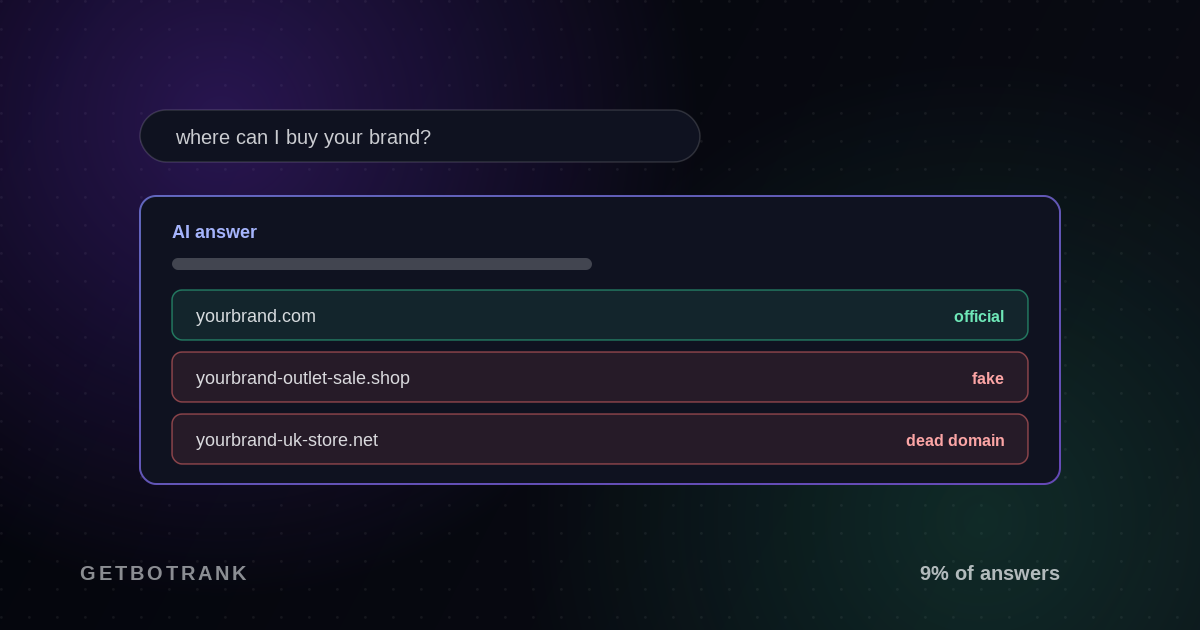
AI chatbots do sometimes send shoppers to fake stores. In a study of 6,795 shopping answers reported this week, ChatGPT, Gemini and Perplexity exposed the user to a counterfeit, impersonator or dead domain in about 9% of responses, and most of the time they recommended the site rather than warned about it. For brands, the fix is to make the official buying path impossible to misread, clean up lookalike and expired domains, and check what the assistants actually say on a schedule.
What the study found
The research comes from Podqi, an IP protection company, and was first reported by The Verge on November 12, 2026. According to Gadget Review's summary, Podqi wrote its own shopping prompts (where to buy a brand, which sites carry it, whether regional storefronts exist) and ran them on ChatGPT, Gemini and Perplexity in two rounds in September, covering 151 brands.
The headline numbers, as reported by Startup Fortune and DigitalToday:
- About 9% of answers surfaced a risky site, meaning a retailer impersonator, a counterfeit seller, an abandoned domain picked up by someone else, or an inactive domain.
- By engine: Perplexity 15%, ChatGPT 8%, Gemini 4%.
- 718 risky domains were flagged in total, 351 fake and 367 inactive.
- When a risky site appeared, 57% of answers recommended it as a place to buy, 34% mentioned it without comment, and only 9% warned about it.
- ChatGPT was the most likely to add a warning, but still did so in only 24% of the cases where it surfaced a risky site.
- Smaller brands had roughly double the exposure of large ones, and questions about regional or country storefronts were the worst category at 16%.
One example stands out: Perplexity named the wrong page as Stüssy's official site and described it as a source of authentic products. Brands named in the test set include Lululemon, Birkenstock and Le Creuset.
The companies responded in general terms. Per the coverage, OpenAI said it is improving safeguards against deceptive shopping results, Perplexity said it does not claim perfect accuracy and is working on it, and Google pointed to Gemini's source links and its lower rate in the study.
A caveat worth keeping: Podqi sells brand protection, the prompts were its own, and the data is a one-month snapshot. None of the articles we read links to the full report. The direction is still hard to ignore.
Why this is a visibility problem, not just a fraud problem
Most brand teams file counterfeit sites under legal or trust and safety. This study shows why AI search teams should care too.
The assistant is now the shopping agent. When someone asks an assistant where to buy your product, the answer is a short list, not ten blue links. If one of three names on that list is a fake, that is a large share of the answer, and it carries the assistant's implied endorsement.
Gaps get filled. The worst results came from regional questions and brands without an official store in a country. If you do not clearly state where you sell and where you do not, the model will find something that looks like an answer. A dead or re-registered domain with your name in it is an easy match.
Dead domains count. Half of the flagged domains were inactive rather than outright fakes. Old campaign microsites, retired country domains and lapsed distributor sites still sit in the sources models learned from or retrieve. Once a domain lapses, anyone can buy it.
Small brands are hit harder. Large brands have a dense web of authoritative mentions that point to the real store. Smaller brands have fewer signals, so a single convincing lookalike can carry more weight.
We made a related point about Google in Google Now Shows AI Overviews for Brand Searches Where the Knowledge Panel Was: the summary of your brand is increasingly written by a model from sources it chooses. Where-to-buy answers are the same problem with money attached.
What to do this month
- Run the shopper's questions yourself. In ChatGPT, Gemini, Perplexity and Claude, ask where to buy your brand, whether your main domain is the official store, and whether you sell in each of your top countries. Ask about your top two or three product lines by name. Write down every domain each assistant names.
- Check every domain on that list. Sort them into official, authorized retailer, unknown and risky. Anything unknown gets a closer look: who owns it, whether it is live, and whether it uses your logos or product photos.
- Publish an unambiguous where-to-buy page. List your official store, your authorized retailers and marketplaces, and the countries you ship to, in plain text. Just as important, say where you do not have a store and how shoppers in those countries can buy. That gives models a real answer for the gap they currently fill with guesses.
- Back it with structured data. Use Organization markup on your site with your official URL and
sameAslinks to your verified profiles, so there is one consistent statement of who you are. Validate the JSON-LD before you ship it, and use the Brand Entity Checker to see whether you have a Wikidata entity that ties those profiles together. - Audit your own old domains. List every domain you have used for country sites, campaigns or past rebrands. Renew the ones you still hold and redirect them to the right store. For lapsed ones that are now in someone else's hands, talk to your legal or brand protection team about takedowns.
- Make sure assistants can read the real store. If your store blocks AI crawlers or renders product details only with JavaScript, the assistant may have little to go on except third-party pages. Our ecommerce holiday playbook covers product page basics for AI shopping answers.
- Report bad answers. All three assistants have feedback controls on responses. Reporting a fake store will not fix the problem alone, but it is free and it documents the issue.
- Repeat on a schedule. Answers change as models and sources change. A one-time check tells you about today, not about the week before Black Friday.
Measuring it over time
The hard part of step 8 is doing it consistently: same questions, same engines, every week, with the results compared. That is the job GetBotRank's Visibility Tracker is built for. It runs buyer-intent questions across ChatGPT, Claude and Gemini on a schedule and tracks how often and how your brand is mentioned, so you can add where-to-buy and regional questions to your prompt set and notice when the answers drift. The page audits then help you check whether your official store pages are readable and ready to be cited.
If you want a quick first look, the free AI visibility audit checks whether AI crawlers can access your key pages, no signup needed.
The bottom line
A 9% rate sounds small until you remember that every one of those answers was a buyer ready to spend money on your brand. You cannot control what ChatGPT or Perplexity says directly, but you can control how clear your official buying path is, which old domains are still floating around with your name on them, and how quickly you notice when an assistant gets it wrong.
Frequently asked questions
How often do AI chatbots recommend fake stores?
In a study by IP protection firm Podqi, reported on November 12, 2026, about 9% of 6,795 shopping answers across ChatGPT, Gemini and Perplexity exposed the shopper to a risky site: a retailer impersonator, a counterfeit seller, a re-registered abandoned domain or a dead domain. Perplexity's rate was 15%, ChatGPT's 8% and Gemini's 4%. The tests ran in September across 151 brands, so treat the numbers as a snapshot.
Which brands are most at risk of AI chatbots recommending fake sites?
According to coverage of the Podqi study, smaller brands had roughly double the exposure of large ones, and questions about regional or country-specific storefronts were the worst category at 16%. Brands that have no official store in a given country were especially exposed, because the chatbot filled the gap with a site that only looked official.
Can a brand stop ChatGPT or Perplexity from recommending a fake store?
There is no direct control panel for this today. What brands can do is make their official stores unambiguous (a clear where-to-buy page, an authorized retailer list, Organization markup with sameAs links), take down or reclaim lookalike and expired domains, and run their own where-to-buy prompts on a schedule so a wrong answer is caught and traced to its source quickly.
How do I check what AI chatbots say about where to buy my products?
Ask ChatGPT, Gemini, Perplexity and Claude the questions a shopper would ask: where to buy your brand, whether a specific site is official, and whether you ship to or have a store in each key country. Record every domain they name and check each one. Repeat monthly, since answers change as sources and models change.