AI Visibility Prompts: How to Pick the Questions Worth Tracking
Which AI visibility prompts should you track? A practical method to build a small, buyer-intent prompt set for ChatGPT, Claude and Gemini that you can trust.
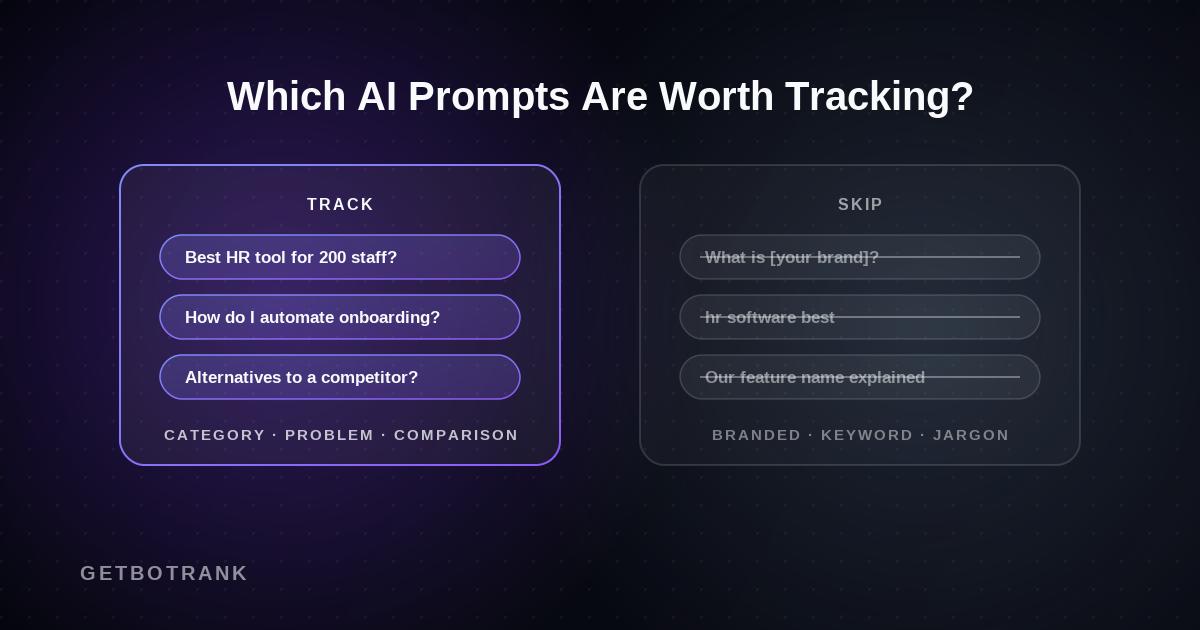
The best AI visibility prompts are the questions a real buyer types into ChatGPT, Claude or Gemini before they know your brand: category questions, problem questions and comparison questions, written in their words and kept fixed over time. A small set of 5 to 10 of these per brand, run on a schedule, tells you more than a hundred branded or keyword-style prompts. If a prompt would not change what you do when the result moves, it does not belong in the set.
Picking prompts sounds like admin work, but it is the step that decides whether your AI visibility numbers mean anything. A tracker can only report on the questions you give it. Feed it vanity prompts and you get a flattering chart that no buyer ever sees.
Why prompt choice matters more than tool choice
Every AI visibility tool, including ours, follows the same basic loop: send a set of questions to one or more AI assistants, read the answers, and count how often your brand (and your competitors) show up. The metric that comes out, usually a mention rate or share of voice, is only as good as the questions that went in.
Three things make this harder than keyword tracking:
- AI assistants do not publish prompt volumes the way search engines expose keyword data. You are partly guessing at what buyers ask, so the guess needs to be grounded in real conversations.
- Answers vary from run to run. The same question can name different vendors on different days, which is why a single check is noise and a repeated, scheduled check is signal.
- Wording shifts results. "Best CRM for startups" and "what CRM should a 10-person startup use" can return different shortlists. Changing a prompt mid-quarter quietly breaks your trend line.
We touched on the wider measurement gap in the GEO analytics problem. Prompt selection is where you close the part of that gap you control.
The four prompt types worth tracking
Sort candidate prompts into four buckets. A healthy set leans heavily on the first three.
1. Category prompts. The buyer knows what kind of product they want and asks for options. "What are the best project management tools for agencies?" "Which payroll software works for companies with staff in India and the US?" These are the closest equivalent to a shortlist, and being absent here is the most expensive gap.
2. Problem prompts. The buyer describes a pain, not a product. "How do I stop clients from changing scope mid-project?" "Why are my Shopify product pages not showing up in ChatGPT?" Assistants often answer with a method and then name tools. Mentions here reach buyers earlier, before the shortlist forms.
3. Comparison and alternative prompts. "Asana vs Monday for a design team." "Alternatives to [competitor] for small teams." These capture buyers who already know the market. Track the competitors you actually lose deals to, not every name in the category.
4. Branded prompts (kept separate). "Is [your brand] good for enterprise?" "What does [your brand] cost?" These tell you whether AI describes you accurately: pricing, features, positioning. They are worth checking, but they will almost always mention you, so mixing them into your visibility rate inflates it. Report them on their own.
A five-step method to build your prompt set
Step 1: Collect real buyer language. Pull phrasing from places buyers already talk to you: sales call notes, demo request forms, support tickets, onsite search, community threads and the "how did you hear about us" field. Ask your sales team which questions prospects ask in the first call. You want their words, not your positioning copy.
Step 2: Write questions, not keywords. Turn each idea into a full sentence a person would type to an assistant. Include the context buyers naturally add: team size, industry, region, budget or a constraint. "Best email tool" becomes "what email marketing tool should a small ecommerce brand use if we already sell on Shopify?"
Step 3: Remove your brand and your jargon. Strip out your product name, internal feature names and category terms only your team uses. If a buyer would not say it, the prompt measures your vocabulary instead of your visibility.
Step 4: Score each candidate. For each prompt, ask three questions:
- Would a buyer asking this be ready to evaluate vendors soon?
- Is there a page on our site that should earn the mention?
- If our mention rate on this prompt dropped, would someone act on it?
Keep prompts that pass all three. A prompt with no matching page is still useful, but it goes on your content backlog rather than your dashboard.
Step 5: Freeze the set and run it on a schedule. Lock the wording, run every prompt across the same engines on a regular cadence, and repeat each prompt more than once per check so a single unusual answer does not swing the result. Review the set quarterly, and add new prompts as a separate batch so your baseline survives.
Common mistakes that skew AI visibility data
- Too many branded prompts. A 90 percent mention rate built on "what is [brand]" questions is not visibility. It is a mirror.
- Keyword-style prompts. Short head terms like "AI visibility tool" are how people search Google, not how they talk to an assistant. Results can look nothing like what real users see.
- One engine only. ChatGPT, Claude and Gemini draw on different sources and often name different vendors. Your buyers do not all use the same one.
- Constant rewording. Every edit resets the baseline. If you must change a prompt, retire the old one and start the new one fresh.
- Tracking without a page to fix. If no page on your site answers the question well, a low mention rate is a content problem first. Our guide on structuring content so LLMs cite it covers what that page should look like.
Example: a starter set for a B2B SaaS brand
Imagine an HR software company selling to mid-sized firms. A first set of eight might look like this:
- What HR software is best for a company with 200 employees?
- Which HR platforms handle payroll and leave tracking in one tool?
- How do I automate employee onboarding without hiring more HR staff?
- What is the easiest way to track PTO for a hybrid team?
- [Main competitor] vs [second competitor] for a mid-sized company
- Alternatives to [main competitor] for companies that have outgrown spreadsheets
- What HR software do growing tech companies use?
- How should a 150-person company choose an HRIS?
Two category prompts, three problem prompts, two comparison prompts and one evaluation prompt, with no brand name anywhere. Branded accuracy checks would sit in a separate group. For more on how software buyers use assistants to shortlist, see AI search visibility for B2B SaaS.
What to do this week
- Gather 20 to 30 raw questions from sales, support and search logs.
- Rewrite them as full buyer sentences and strip out brand names and jargon.
- Score them against the three questions above and keep the best 5 to 10.
- Map each surviving prompt to the page that should earn the mention, and confirm AI crawlers can actually reach that page with our free crawler access checker.
- Run the set on a schedule across ChatGPT, Claude and Gemini, and leave the wording alone for a quarter.
If you would rather not run this by hand, GetBotRank's Visibility Tracker does the scheduled part: it suggests buyer-intent questions for your brand, runs each one across ChatGPT, Claude and Gemini, tracks your mention rate against competitors, and pairs that with page audits so you can fix what is holding a page back and re-check it. The free plan covers one brand with five questions, which is enough to test a first set. Or start with the no-signup free AI visibility audit to see whether your key pages are readable by AI in the first place.
Frequently asked questions
What are AI visibility prompts?
AI visibility prompts are the questions you run through AI assistants such as ChatGPT, Claude and Gemini to see whether your brand is mentioned in the answer. A good prompt reads like something a real buyer would type before shortlisting vendors, not a query built around your brand name.
How many prompts should I track for AI visibility?
Start small: 5 to 10 well-chosen buyer-intent questions per brand is enough to see a trend, as long as you run them on a schedule and keep the wording fixed. Adding more prompts helps only after the first set is stable and each prompt maps to a page or decision you can act on.
Should my AI visibility prompts include my brand name?
Mostly no. Prompts that name your brand measure what AI says about you, which is useful for accuracy checks, but they almost always return a mention and inflate your visibility rate. Keep branded prompts in a separate group and judge visibility on unbranded category and problem questions.
How often should I change my tracked prompts?
Rarely. Changing wording resets your baseline, so treat the core set as fixed for at least a quarter. Review it every few months, retire prompts that no longer match how buyers talk, and add new ones as a separate batch so you can still compare like with like.