AI Search Visibility for B2B SaaS: How Buyers Shortlist Software in ChatGPT
Half of B2B software buyers now start research in an AI chatbot. How AI search visibility works for B2B SaaS, what shapes shortlists, and what to fix first.
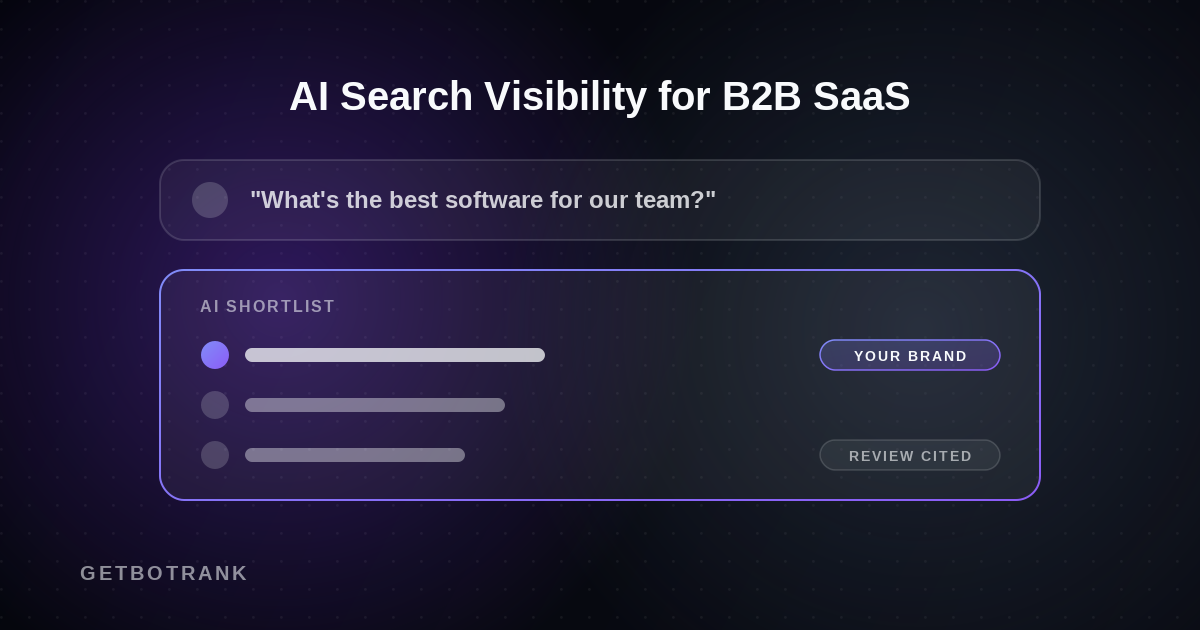
AI search visibility for B2B SaaS means one thing in practice: when a buyer asks ChatGPT, Claude or Gemini for the best tools in your category, your product is named, described accurately and backed by sources the buyer trusts. It matters because the shortlist now often forms inside that answer. In G2's March 2026 survey, 51% of software buyers said they start research in an AI chatbot more often than in Google.
This post covers what the latest buyer research says, how assistants assemble a software shortlist, and the fixes that move a SaaS brand from absent to included.
What the buyer data says
G2 has published two large buyer studies this year, and both point the same way.
The Answer Economy report, based on a March 2026 survey of 1,076 B2B software buyers, found:
- 51% start software research in an AI chatbot more often than in Google, up from 29% in G2's 2025 study.
- 71% use AI chatbots somewhere in their research, while 80% still use Google somewhere. It is not either/or.
- 69% chose a different vendor than they first expected because of a chatbot recommendation, and 33% bought from a vendor they had not considered before.
- ChatGPT's share among these buyers rose from 47% to 62% in a year, and G2 says Claude more than doubled its share in seven months.
The news release for that report adds that 85% of buyers think more highly of a vendor when an AI answer cites it.
Then in July, G2's 2026 Buyer Behavior Report, drawn from more than 1,000 buyers, found that 82% had sourced software recommendations from an AI chatbot in the previous 24 months. Half of them said AI mattered most when narrowing and comparing options, which is exactly where a shortlist gets made.
For a SaaS marketing team, the takeaway is blunt. A buyer who never sees your name in the AI answer may never reach your site, your demo form or your sales team.
Reviews and AI answers are now one channel
The most useful detail in G2's research is how tightly AI answers and review sites are linked.
In the March survey, AI chatbots were the top influence on shortlists (54%), with review sites second (43%). By the July report, review sites had moved ahead for the first time, 38% to 37%. The surveys differ in timing and wording, so the swap is less important than the pattern: these two sources now dominate shortlisting, well ahead of vendor salespeople (19% in the March survey).
They also feed each other. G2 found that citations from software review sites were the single most confidence-inspiring signal inside an AI answer, chosen by 45% of buyers. So when ChatGPT recommends a CRM and cites a review profile, the buyer trusts the answer more. When your review profile is thin, outdated or inconsistent with your own site, the assistant has less to work with and the buyer has less reason to believe it.
Bias note: G2 runs a review site, so it has an interest in this conclusion. The figures still come from large surveys with stated sample sizes and methods, which is more than most AI search statistics can claim.
How assistants build a software shortlist
No assistant publishes its ranking logic, but the inputs are visible in the answers and the sources they cite. For B2B software they usually come from four places.
- Category and comparison content. "Best X tools" lists, analyst roundups and alternatives pages. G2 found buyers' first prompts are most often category-based (33%) or competitor-based (31%), so these pages get pulled constantly.
- Review profiles. Ratings, review recency and the language customers use to describe what you do.
- Your own site. Feature pages, pricing, integrations, docs and security pages, when crawlers can reach and read them.
- Community discussion. Forum and social threads where practitioners compare tools.
One more finding deserves attention: 64% of buyers in G2's survey said they run into AI inaccuracies a few times a month or more. When an assistant gets your pricing, integrations or target customer wrong, it is usually filling a gap your public content left open.
Where SaaS sites lose visibility
These are the technical and content gaps that most often keep a SaaS product out of AI answers. Each one is quick to check.
- Pages that need JavaScript to show anything. Marketing sites built as single-page apps can serve near-empty HTML to crawlers that do not render scripts.
- AI crawlers blocked by default. A CDN bot rule or an old robots.txt line can keep GPTBot, ClaudeBot or PerplexityBot out without anyone deciding that.
- Vague positioning. "The all-in-one platform for modern teams" gives a model nothing to match against "project management tool for agencies with client portals."
- Pricing and integrations hidden behind forms or images. Buyers ask about cost and fit early. If the answer is not in readable text, the assistant guesses or skips you.
- No honest comparison pages. If you never explain how you differ from the category leader, third parties explain it for you.
What to do this quarter
- Write your prompt set. List 20 to 30 questions in the shapes G2 found buyers use: category ("best SOC 2 compliance software for startups"), competitor ("alternatives to [leader]"), and requirement ("tools that integrate with HubSpot and Slack"). Run them in ChatGPT, Claude and Gemini and record who gets named.
- Check that AI crawlers can get in. Test your homepage, pricing, features and docs with the AI crawler access checker. Fix accidental blocks first, since nothing else matters if bots cannot read the page.
- Make key pages quotable. Put a one-sentence answer to "what is it and who is it for" near the top of feature and category pages, then plain-text specifics: integrations, limits, pricing tiers, compliance. The AI Citability Analyzer scores each passage, and our guide to structuring content so LLMs cite it covers the format.
- Publish fair comparison and alternatives pages. Cover the competitors buyers actually name, state where they fit better, and keep facts dated. Assistants favor sources that read as balanced.
- Treat reviews as a visibility input. Ask for reviews steadily rather than in bursts, and keep your review profiles consistent with your site's positioning and pricing.
- Re-run the prompt set on a schedule. AI answers shift as models refresh sources. Track mention rate per prompt and per engine monthly, and tie changes to the fixes you shipped.
Step six is where most teams stall, because running dozens of prompts across three assistants by hand gets old fast. That is what GetBotRank's Visibility Tracker automates: it runs your buyer-intent questions across ChatGPT, Claude and Gemini on a schedule, tracks how often your brand is mentioned, and pairs that with page audits so you can diagnose a gap, fix it and confirm the fix worked.
The bottom line
For B2B SaaS, the AI answer has become the first sales conversation. Buyers ask a chatbot, compare what it says against review sites, and walk into a demo with a shortlist already formed. The brands that make that list are readable by crawlers, specific about who they serve, honest about how they compare and well reviewed in public.
If you want a quick baseline, run a free AI visibility audit on your pricing or main feature page. It shows whether AI crawlers can reach and read it, and what to fix first.
Frequently asked questions
How many B2B software buyers use AI chatbots to research vendors?
In G2's March 2026 survey of 1,076 buyers, 51% said they start software research in an AI chatbot more often than in Google, up from 29% the year before, and 71% use chatbots at some point. G2's July 2026 Buyer Behavior Report found 82% had sourced software recommendations from an AI chatbot in the previous 24 months.
Do review sites still matter if buyers ask ChatGPT?
Yes, arguably more. In G2's research, citations from software review sites were the most confidence-inspiring signal inside an AI answer (45% of buyers), and in the July 2026 report review sites edged out AI chatbots as the top source shaping shortlists, 38% to 37%. Assistants often lean on the same review profiles buyers read.
What prompts should a B2B SaaS company track in AI search?
Start with the prompt types buyers actually use. G2 found first prompts are most often category-based (33%), competitor-based (31%) or about requirements and process (22%). Track a mix such as best tools for a category, alternatives to a named competitor, and tools that meet a specific requirement or integration.
How is AI search visibility different from SEO for SaaS?
SEO measures where your pages rank. AI search visibility measures whether an assistant names your product when a buyer asks for options, and how it describes you. Good SEO helps, but the answer also draws on review sites, comparison articles, docs and pricing pages, so a brand can rank well and still be missing from AI shortlists.