AI Search Visibility for Local Businesses: Getting Recommended in ChatGPT
Nearly half of consumers now ask AI for local business picks. How AI search visibility works for local businesses, why most get skipped, and what to fix first.
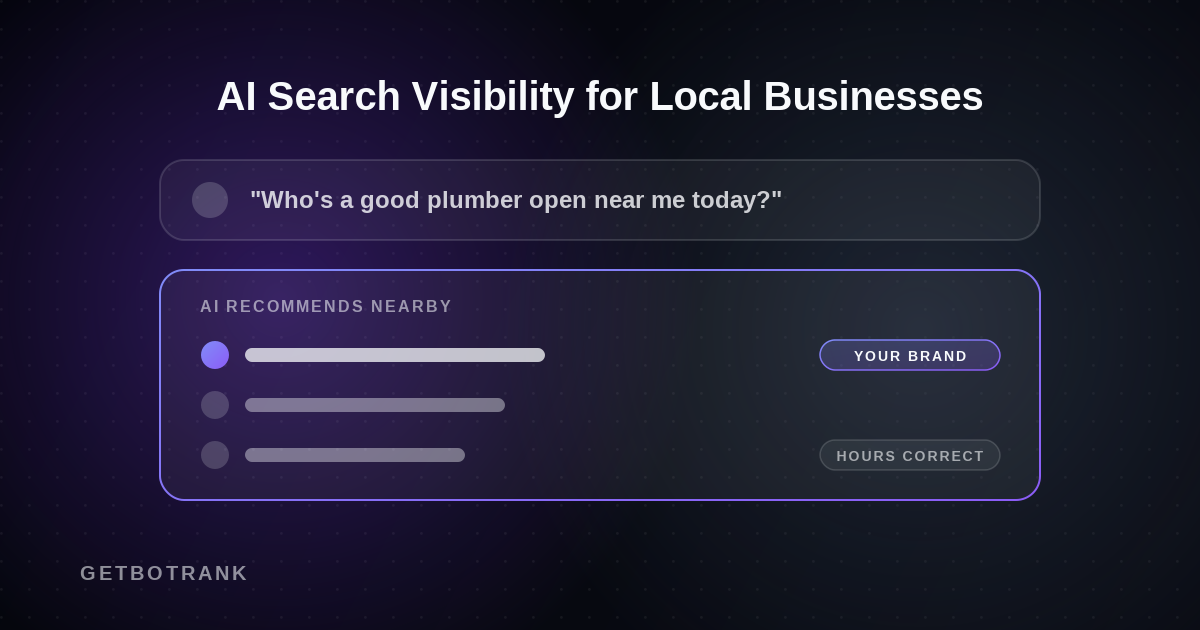
AI search visibility for a local business means that when someone asks ChatGPT, Gemini or Google's AI Mode for "a good plumber near me" or "the best brunch spot in [neighborhood]," your business gets named, with the right hours, location and services. It matters because this is now a mainstream habit: BrightLocal's 2026 survey found 45% of US consumers used AI tools for local business recommendations, up from 6% a year earlier. Most businesses are not showing up yet, and the ones that do tend to have consistent facts, readable pages and steady reviews.
This guide covers what the 2026 data says, how AI assistants decide which local businesses to recommend, and a short list of fixes you can work through this month.
What the 2026 data says
Four separate studies this year point in the same direction, even though each measured something slightly different.
- BrightLocal surveyed 1,002 US adults for its Local Consumer Review Survey. As reported by DesignRush, 45% used ChatGPT or other generative AI tools for local recommendations, while Google's share as a source fell from 83% to 71%.
- SOCi's 2026 Local Discovery Index, a July survey of more than 1,000 US consumers, found that 52% had used an AI tool to find a local business in the last 30 days, compared with 9% in the previous year's edition. ChatGPT (57%) and Gemini (51%) were the most used assistants.
- Yext's 2026 Consumer Search Behaviors sneak peek, from a spring survey of 3,848 adults in five countries, found 44% had used an AI tool for local search in the past month, including 47% in the US. Yext notes its findings are directional.
- Adoption is uneven by age. SOCi found millennials (63%) far ahead of baby boomers (11%), so businesses with younger customers feel this shift first.
Because the questions differ (past 30 days, past month, past year), the figures should not be compared directly. The pattern is what counts: AI went from a curiosity to a regular local discovery channel in about a year.
Most local businesses are invisible in AI answers
Use is high, but recommendations are concentrated. A SOCi Local Visibility Index analysis of more than 350,000 locations, cited in a March 2026 press release, found that ChatGPT recommended just 1.2% of the local business locations studied. An AI answer usually names a short list rather than a full page of results, so there is no "page two" to fall back on: you are either mentioned or you are not.
The same release reports only partial overlap between brands that perform well in traditional local search and those that appear in AI recommendations. Strong local SEO helps, but it does not guarantee a mention.
Accuracy is the second problem. In SOCi's survey, 67% of AI users had been given wrong information about a local business at least once, and 30% said it caused a real inconvenience. Wrong hours or a closed location in an AI answer costs you the visit and some trust along with it.
Customers still check before they call
AI usually starts the journey, not ends it. BrightLocal's separate Consumer Search Behavior Survey, summarized by EMARKETER, found 75% of consumers who used AI to find a local business checked Google or Maps before contacting it. Yext's data shows the same habit: 53% of AI users searched Google or Bing to verify, 49% visited the business website and 28% checked reviews.
SOCi found 81% take some verification step, with reviews the most common one. Responding to reviews matters too: 72% of consumers said they favor businesses that respond.
So AI visibility and classic local presence are one system. The AI answer gets you on the shortlist; your Google Business Profile, website and reviews close it.
How AI assistants pick local businesses
No assistant publishes its ranking logic, but the inputs show up in the answers and cited sources. For local queries they usually draw on:
- Listings and maps data. Business profiles and directories supply names, addresses, hours and categories. Inconsistent data across them makes a business riskier to recommend.
- Reviews. Ratings, volume, recency and the words customers use ("fast emergency repair," "great for kids") help match you to specific requests.
- Your website. Service pages, location pages, prices and FAQs, provided crawlers can reach and read them.
- Third-party mentions. Local news, "best of" lists, community forums and neighborhood guides.
The practical lesson is specificity. A page that says "family dentist in Austin, open Saturdays, accepts walk-ins for emergencies" matches far more real questions than "quality dental care for the whole family."
What to do this month
- Make your core facts identical everywhere. Name, address, phone, hours, services, service area and price ranges should match across your website, Google Business Profile, Apple Maps, Bing Places, Yelp and industry directories. Fix holiday hours before the season, not after.
- Check that AI crawlers can reach your pages. Run your homepage and key service pages through the AI crawler access checker. Website builders and CDN bot rules sometimes block GPTBot, ClaudeBot or PerplexityBot without anyone choosing that.
- Build one page per service and area. Prioritize service and location pages over blog posts. Put a plain one-sentence answer at the top (what you do, where, for whom), then details in text: hours, prices or price ranges, booking options, parking, languages spoken. Our guide on structuring content so LLMs cite it covers the format.
- Add LocalBusiness schema, but keep expectations modest. Use the schema validator to check your markup. Structured data helps describe you clearly, but as we covered in schema markup for AI search, it will not earn citations on its own. Every value in it should also appear in visible text.
- Ask for reviews steadily and reply to them. A steady flow beats a one-time push, and reviews that mention specific services give assistants language to match against.
- Ask the assistants yourself. Write 10 to 15 questions your customers would ask ("emergency electrician open Sunday in [city]," "kid-friendly dentist near [neighborhood]") and run them in ChatGPT, Gemini and Claude. Note whether you appear, who does instead, and anything stated about you that is wrong.
Step six is where it usually breaks down, because answers shift as models update and checking by hand every month is tedious. GetBotRank's Visibility Tracker runs your buyer-intent questions across ChatGPT, Claude and Gemini on a schedule and tracks how often your business is mentioned, while page audits show what to fix on the pages behind those answers. Multi-location brands get the most from it, since gaps tend to cluster by city.
The bottom line
Local discovery now often starts with a question to an AI assistant, and the answer names only a handful of businesses. The ones that make the list have consistent facts everywhere, pages crawlers can read, specific service and location content, and a steady stream of reviews that back up what the AI says.
For a quick baseline, run a free AI visibility audit on your main service page. It shows whether AI crawlers can reach and read it, and what to fix first.
Frequently asked questions
How many people use AI to find local businesses?
Several 2026 surveys put it near half. BrightLocal found 45% of US consumers used AI tools for local business recommendations, up from 6% a year earlier. SOCi's 2026 Local Discovery Index found 52% had used an AI tool to find a local business in the past 30 days, and Yext found 47% of US respondents used one for local search in the past month.
Does Google Business Profile still matter if customers ask ChatGPT?
Yes. Most people verify AI recommendations before they call or visit. BrightLocal data reported by EMARKETER found 75% of consumers who used AI to find a local business checked Google or Maps first, and Yext found 53% of AI users searched Google or Bing to verify. Your profile and reviews are where the AI recommendation gets confirmed or lost.
Why does ChatGPT give wrong information about my business?
Usually because your details are missing, inconsistent or hard to read across your website, listings and review sites, so the model fills gaps or relies on stale sources. In SOCi's 2026 survey, 67% of AI users said they had been given wrong information about a local business at least once. Consistent hours, address, services and prices in plain text reduce the problem.
What should a local business fix first for AI search?
Start with consistent core facts (name, address, phone, hours, services, service area) across your site, Google Business Profile and major directories. Then make sure AI crawlers can reach and read your service and location pages, build dedicated pages for each service and area, and keep reviews coming steadily.