Schema Markup for AI Search: What It Does and Doesn't Do for Citations
Does schema markup help you get cited in ChatGPT and AI Overviews? What the 1,885-page Ahrefs study found, what schema is still good for, and what to fix first.
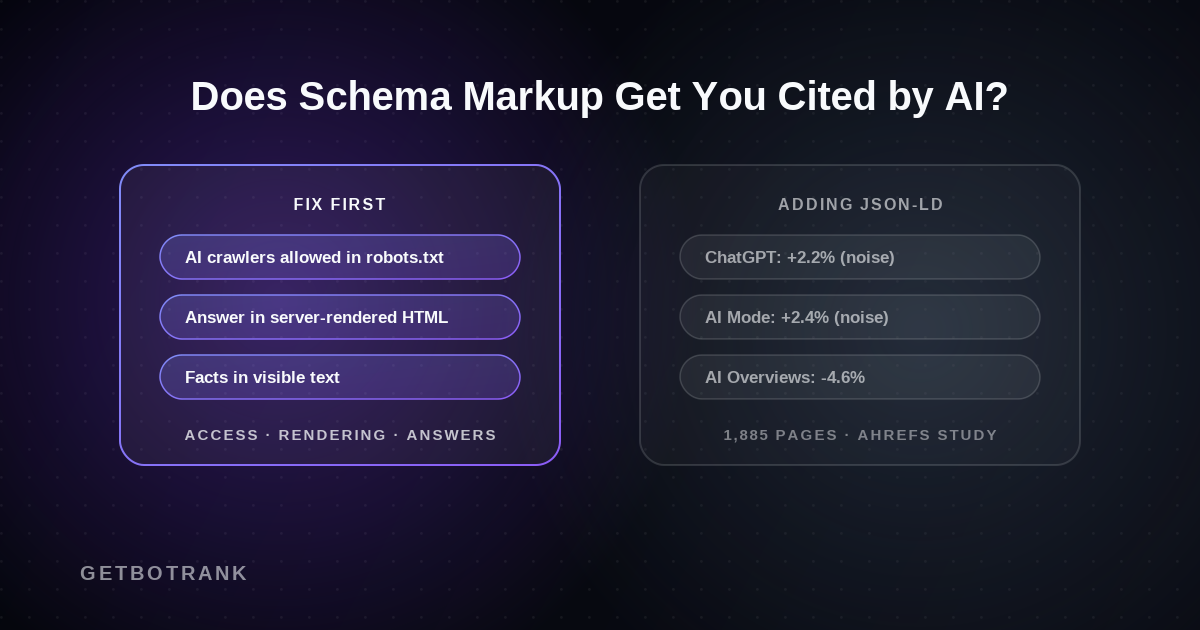
Schema markup on its own does not get your brand cited by ChatGPT, Gemini or Google's AI features. The largest test so far, an Ahrefs study of 1,885 pages that added JSON-LD, found no meaningful citation lift after the change. Schema is still worth keeping for rich results and for describing your brand unambiguously, but the things that move AI citations are crawl access, server-rendered text and content that answers the question.
That is a less exciting answer than "add FAQ schema and get cited," which is why it is worth walking through the evidence and what to do instead.
What the Ahrefs study measured
In May 2026, Ahrefs published a study tracking pages that added JSON-LD structured data between August 2025 and March 2026, as reported by Search Engine Roundtable. The setup was careful for this kind of research:
- 1,885 pages that added schema, each compared against control pages from other domains with similar citation levels beforehand (TechWyse's write-up describes three controls per page).
- Citation rates measured 30 days before and 30 days after the schema was added, using a difference-in-differences comparison.
- Three surfaces: Google AI Overviews, Google AI Mode and ChatGPT.
The results, consistent across every summary we read:
| Surface | Change vs. control pages | What it means |
|---|---|---|
| ChatGPT | +2.2% | Too small to separate from noise |
| Google AI Mode | +2.4% | Too small to separate from noise |
| Google AI Overviews | -4.6% | Statistically significant, but pages were already declining before schema was added |
Ahrefs' own summary, quoted by Search Engine Roundtable, was that adding schema produced no major uplift on any platform. Elevarus' breakdown adds that Ahrefs did not attribute the AI Overviews dip to schema itself, because the downward trend started earlier.
The limits worth knowing
No single study settles this, and the authors flagged its gaps. Every page in the sample already had 100 or more AI Overview citations, so it tells you about established pages, not new ones. All schema types were pooled together. Schema changes often ship alongside other page edits. And 30 days may be too short to catch slower effects. Treat the result as "no evidence of a quick win," not "schema is useless."
Why schema and AI citations look correlated anyway
If you have seen claims that schema helps AI visibility, they usually rest on correlation. TechWyse cites an analysis of 6 million URLs in which pages cited by AI were roughly three times more likely to include JSON-LD.
That correlation is real, but it says more about who adds schema than what schema does. Sites with structured data tend to have technical SEO resources, clean templates, server-rendered HTML and well-organized content. Those traits help with AI citations by themselves. The Ahrefs before-and-after design tries to strip that out, and once it does, the effect mostly disappears.
How AI assistants actually read your page
The more useful finding is about how assistants consume pages. According to the Elevarus summary of the Ahrefs report, a searchVIU experiment tested ChatGPT, Claude, Perplexity, Gemini and Google AI Mode and found that none of them used JSON-LD when fetching a page directly. Hidden Microdata was ignored too.
In practice that means:
- The visible text is the product. If your price, specs, author or opening hours live only in a JSON-LD block, a live-fetching assistant may never see them.
- JavaScript-rendered content is a bigger risk than missing schema. Many AI fetchers do not run scripts, so content that only appears after rendering can be invisible. We covered this in what an AI crawler actually sees on your page.
- Indexing and training may be different. Schema could still help search engines and model builders understand your pages at index time. Nobody has measured that cleanly yet, which is another reason not to rip existing markup out.
Google's position points the same way. CMSWire notes that Google's own guidance says no special schema is needed to appear in AI Overviews or AI Mode. The normal SEO fundamentals apply.
What schema is still good for
None of this means you should delete your structured data. It still earns its place in a few specific ways:
- Rich results in classic search. Product, review, event, video and article markup can still change how your listing looks in Google, and classic rankings still feed what AI systems retrieve.
- Entity clarity. Organization markup with
sameAslinks to your LinkedIn, Wikipedia or Wikidata entries helps machines tell your company apart from similarly named ones. It works best when those profiles actually exist and describe you consistently. - Data hygiene. Writing markup forces you to state the facts of a page (name, price, author, date) explicitly. If those same facts are visible in the text, assistants benefit too.
What schema is not is a citation lever you can pull on its own.
What to do instead: a priority order
If your goal is to be cited in AI answers, work through this list in order. Schema comes near the end, not the start.
- Confirm AI crawlers can reach the page. A blocked GPTBot, ClaudeBot or PerplexityBot in robots.txt, or a CDN rule that challenges bots, stops everything else from mattering. Test any URL with the free crawler access checker.
- Check the server-rendered HTML. Your main answer, key facts and headings should exist before JavaScript runs. Load the page with JavaScript disabled, or view the raw source, to see what a non-rendering fetcher gets.
- Answer the question in the first few sentences. Lead each section with a direct, quotable statement, then support it. Our guide on structuring content so LLMs cite it goes deeper.
- Put facts in the text, not only in markup. Prices, specs, dates and names belong in visible copy. Then mirror them in schema, never the other way round.
- Validate the schema you already have. Broken JSON-LD fails silently. The free schema validator reads what a crawler receives and flags errors.
- Measure, then change one thing at a time. Track whether you are actually mentioned for buyer questions before and after a change. Without that baseline, you cannot tell a real effect from normal answer-to-answer variation.
The bottom line
Schema markup is good technical hygiene and still worth maintaining, but the evidence does not support treating it as a way into AI answers. Spend the effort on access, rendering and clear answers first, and judge every change by whether your brand shows up more often.
If you want a quick read on where your own pages stand, the no-signup free AI visibility audit checks crawler access, rendering and structure in one pass. GetBotRank's Visibility Tracker and page audits then run your buyer questions across ChatGPT, Claude and Gemini on a schedule, so you can see whether a fix, schema or otherwise, actually moved your mention rate.
Frequently asked questions
Does schema markup help you get cited by AI search engines?
Not directly, based on the best evidence so far. An Ahrefs study of 1,885 pages that added JSON-LD found no meaningful citation lift in ChatGPT or Google AI Mode and a small decline in AI Overviews compared with matched control pages. Schema is still useful for rich results and for describing your brand clearly, but it will not fix a page that AI systems do not want to cite.
Do ChatGPT, Claude and Perplexity read JSON-LD?
When these assistants fetch a page live, they appear to work mainly from the visible text. A searchVIU experiment summarized in the Ahrefs report found that the systems it tested did not use JSON-LD during direct retrieval. Schema may still matter at indexing or training time, which no public test has fully measured.
Which schema types are still worth adding?
Keep Organization markup with sameAs links on your homepage, Product, Article and other types that match what the page really is, and anything that powers a rich result you care about in Google. Make sure every value in the markup also appears in the visible text, since that is what AI assistants actually read.
What should I fix before adding more schema?
Check that AI crawlers are allowed in robots.txt, that your key content is in the server-rendered HTML rather than injected by JavaScript, and that each page answers its main question in plain text near the top. These problems block citations far more often than missing structured data.